This site is a combination of family events and other things that catch my interest.
Please feel free to leave a friendly comment, by clicking on the 'comments' link found at the bottom of each article.
Thank you and enjoy!
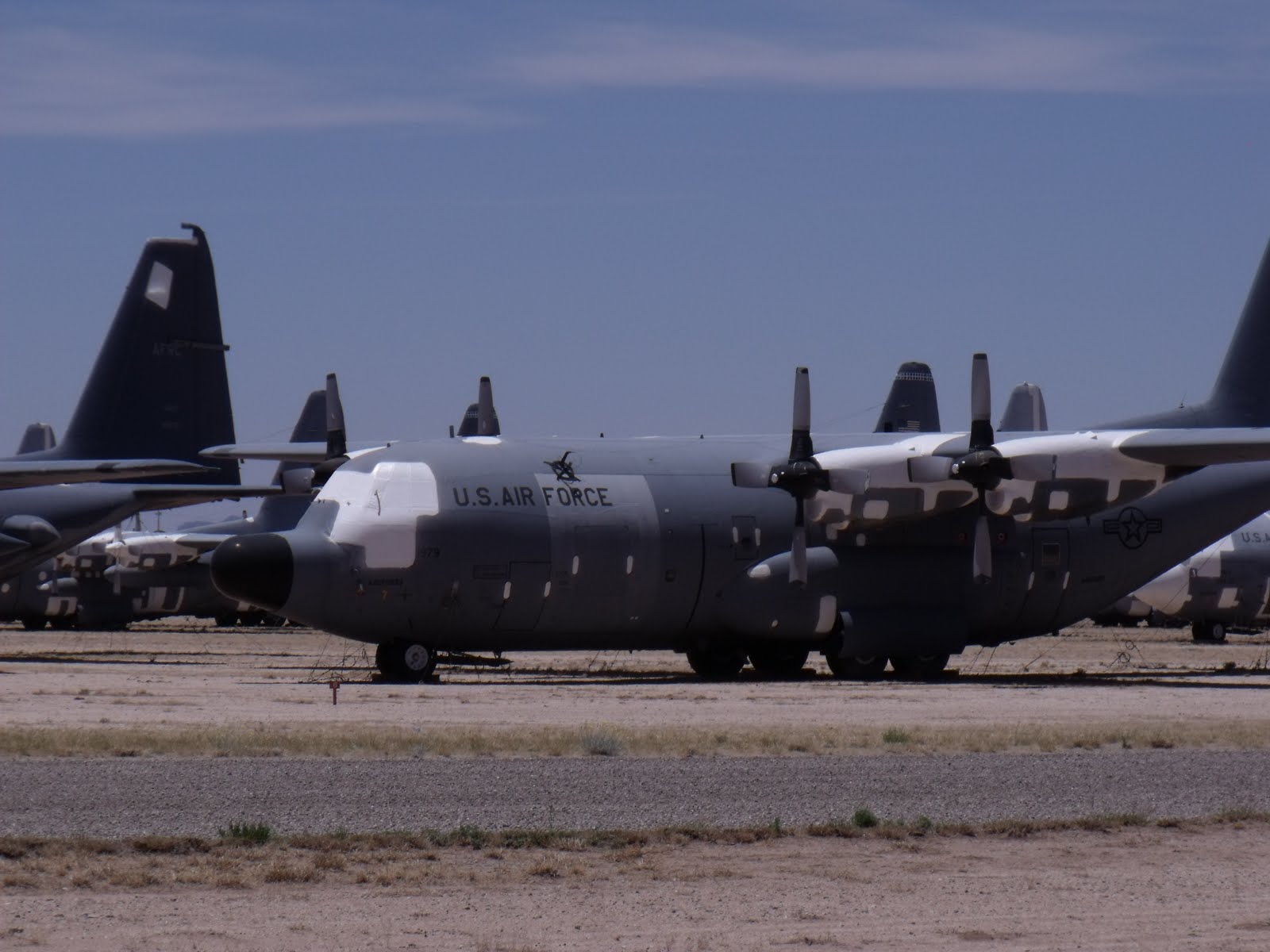
The 'Boneyard', covers approx. 2,600 acres, has an average of 4,200 aircraft stored on site, has approx. 600 employees and is valued around $27 billion.
AMARC, or the Aerospace Maintenance And Regeneration Center, is a joint service facility managed by the US Air Force Material Command located in the town of Tucson, Arizona, USA.
Often referred to as 'The Boneyard', AMARC is an aerospace storage and maintenance facility adjoining Davis-Monthan Air Force Base which provides a service to all branches of the US military (Air Force, Navy, Marines, Coast Guard and Army), as well as other national agencies.
Currently controlling over 4,200 aircraft as well as many other types of military equipment, AMARC works very hard in promoting itself as not just a 'Boneyard' and takes every opportunity in explaining how it operates it's cost effective, tax saving operations. Many of the stored aircraft can be returned to an operational status in a short period of time and there is a continual process of anti-corrosion and re-preservation work which keeps the aircraft in a stable condition during their stay.
The reason the Boneyard reference exists is due to other work that AMARC carries out, that of reclamation of spare parts and the eventual disposal of spent airframes. The Center can be divided into 2 distinct areas, the RIT (Reclamation Insurance Type) area located to the east side of Kolb Road is littered with aircraft in various states of completeness. The junkyard appearance belies the fact that these aircraft are controlled by a process of careful part reclamation, both to a schedule and to ad-hoc requests. On careful examination many of these aircraft can be seen re-sealed to protect the remaining components from the dirt and heat.
There are many times that aircraft from the RIT area leave AMARC to become instructional aircraft, targets on Army or Air Force ranges, museum exhibits or display pieces, although most end up being smelted down into ingots by nearby metal processors.
AMARC has also been heavily involved in the elimination of B-52 Stratofortresses under the Strategic Arms Reduction Treaty (START), and were also responsible for the eliminiation of 445 Ground Launch Cruise Missiles (GLCM) and their launchers under the INF Treaty.
Royal Caribbean's new Oasis of the Seas is the largest, widest, tallest, most expensive cruise ship afloat, a cornucopia of amusements aimed at quashing the notion that cruising is a sedentary vacation, said chief executive Richard Fain.
Then he donned swim trunks, jumped on a boogie board and challenged fellow executives to a contest in one of the Oasis' two FlowRider pools that simulate surfing.
"I've never been a believer in building it big just for size's sake. We build large because we've had so many ideas they simply don't fit in a smaller hull," Fain said. The $1.4 billion Oasis of the Seas, the world's biggest cruise ship, enters service during the industry's worst year in decades but is so exuberantly excessive that Fain predicts it will be profitable from day one.
Oasis is a floating resort that eclipses the condo towers it sails past at its new home, Port Everglades in southeast Florida. The 225,282-gross-ton ship has 16 passenger decks and can carry 6,292 passengers plus 2,165 crew.
It has rock-climbing walls, a basketball court, an ice skating rink, a carousel with hand-carved wooden animals, a shopping promenade lined with cafes and bars, cantilevered whirlpools overlooking the sea and a Central Park with 12,000 live plants and trees.
Zip line An amphitheater surrounds a deep-diving pool on the stern, where high-divers and synchronized swimmers perform. Passengers can harness themselves onto the "zip line" and soar across the ship above an open-air atrium nine decks high and lined with balconied cabins.
One of its many bars, the Rising Tide, floats up and down between three decks, while a touring company performs the Broadway musical "Hairspray" in the 1,380-seat theater.
The Oasis, which starts its inaugural voyage on December 5, was six years in the making and arrives at a time when cruise lines are cutting rates to fill berths.
Net yields, a measure of revenue generated per bed per day, were down 16 percent during the first nine months of 2009 for the major companies, Carnival, Royal Caribbean and Norwegian Cruise Line, said Rod McLeod, a vacation management consultant who has held senior management posts at all three lines.
"Over the last 20 years, that's the steepest level of year-over-year declines in yields, which is understandable given what's happened in the worldwide economy," said McLeod, now with McLeod/Applebaum Partners in Miami.
The cruise lines are cautiously predicting 2010 will be less awful, with yields down by only 7 or 8 percent.
Generally the farther ahead passengers book cruises, the more the lines can charge. The window has begun to widen, with passengers now booking an average of three months ahead, compared with just six weeks in early 2009, McLeod said.
Wave of new ships
But a wave of new ships ordered during the boom times are now coming on line and that will put pressure on rates, a boon for bargain-hunting passengers but not so much for cruise line earnings.
No. 1 cruise line Carnival's newest and biggest ship, the 3,652-passenger Carnival Dream, starts regular cruises to the Caribbean in December out of Florida's Port Canaveral.
Royal Caribbean will launch the Oasis' twin, Allure of the Seas, next December, one of eight new ships due out in 2010 industrywide. Capacity is expected to rise by 7 percent next year, and a little less than that in 2011, before settling.
"No new ships have been ordered for now 20 months and that hasn't occurred in the last 25 years," McLeod said.
New ships tend to attract passengers at the expense of the older ones. Cruise lines are compensating by moving their older ships away from weakening markets like Hawaii and Alaska and into growing ones like Europe and China, "like a giant chess game, playing with boats," he said.
Bookings aboard Oasis have been strong because it offers so much of everything, Royal Caribbean's Fain said.
Seven-night cruises start at $1,049 per person, double occupancy, for an inside cabin and run up to $16,659 per person for the two-story Royal Loft suite, which includes a baby grand piano and private 843-square foot balcony.
"We're getting much higher rates than I certainly would have expected even a year ago. The reception has just been overwhelming. I'm feeling pretty good right now," Fain said.
Zamboni driver needed
Royal Caribbean will see some cost savings from economies of scale on Oasis. Fuel consumption per guest is 30 percent lower than on an average ship and engine room staffing, for example, is not significantly bigger than on other ships because that part of the Oasis is very compact, Fain said.
Other costs are higher because it takes more staff to run its 24 dining venues and service 4,100 toilets, 42 elevators and 4,500 air conditioning units.
"On another ship we don't have high divers and horticulturists, Zamboni operators," Fain said, referring to equipment used to groom ice-skating rinks.
Oasis' size limits its itinerary. It will stop initially at the Caribbean ports of St. Maarten and St. Thomas and the Bahamian capital of Nassau, a week-long voyage that will later alternate with western Caribbean sailings.
Those ports dredged and deepened their approaches and built new docks to accommodate Oasis, while Port Everglades built a whole new terminal to handle the crowd of passengers who will leave the ship as a new horde embarks.
The mega-ship has its detractors. Travel writer Arthur Frommer wrote in his Budget Travel column that it exists to "cater to more of those people who are unable to entertain themselves, those arrested personalities who rely on constant, massive, outside distractions to ward off depression."
An even bigger one?
Other lines are cheering the Oasis, figuring the publicity bonanza will lift all cruise ships. Boutique lines are pitching their smaller more intimate vessels as the anti-Oasis
"Yes they have the most space but they're also putting the most number of guests into that space," said Steve Tucker, vice president of North American field sales for privately held luxury line Silversea, which launches its all-suite Silver Spirit on a 91-day voyage from Port Everglades in December.
At a tenth the size of the Oasis, Silver Spirit offers a private butler in every stateroom and carries 540 passengers.
Fain, meanwhile, is "looking at the forward bookings and smiling" while fending off the inevitable question of whether Royal Caribbean will build a ship even bigger than Oasis.
"I'm not saying it couldn't happen but one would need a reason," he said. "If somebody comes up with an idea that we think would be appealing to our guests, we would certainly look at it."