Showing posts with label Sport. Show all posts

02 August 2008

Colorado Springs is Host to the Senior US Open

This year, Colorado Springs is hosting the Senior U.S. Open at the Broadmoor.


How many other tournaments around the country or around the world for that fact, will you see this.....

A black bear ran across the no. 13 fairway during the second round of the 2008 U.S. Senior Open at the Broadmoor on friday. at the same time the bear was crossing the fairway, Fred Tunk was building his three-shot lead.

09 April 2007

Shanahan stays with the Broncos

Broncos coach Mike Shanahan has signed a three-year contract extension, keeping him in Denver through the 2011 season.

Shanahan, 54, led Denver to Super Bowl victories in 1997 and 1998. Since becoming head coach in January 1995, he has led the Broncos to seven playoff appearances and a 123-69 regular season record, best in the NFL over that span.

Although he's had just one losing season, in 1999, following John Elway's retirement, Shanahan has just one playoff win in the last eight seasons.

Team owner Pat Bowlen announced the extension Monday in a news release. After failing to make the playoffs last season, Shanahan has overseen another major roster makeover this offseason.

The Broncos traded away quarterback Jake Plummer, running back Tatum Bell and offensive lineman George Foster and acquired cornerback Dre Bly, wide receiver Brandon Stokley, quarterback Patrick Ramsey, running back Travis Henry, tight end Daniel Graham and guard Montrae Holland, among other veterans.

Shanahan's victory total with Denver is 11th-best by one coach with one team in NFL history.

Since he became their coach in 1995, the Broncos have led the NFL in points, total yards and yards rushing. Shanahan was head coach of the Los Angeles Raiders from 1988-89.

He has spent 20 years with Denver, joining the team in 1984 and also has served as wide receivers coach, quarterbacks coach and offensive coordinator.

He ranks third among active coaches with 139 career wins, including eight in the playoffs.


11 January 2007

Tribute to 'Williams' of the Denver Broncos

ENGLEWOOD, Colo. -- Tragedy struck the Denver Broncos and the National Football League on Monday morning when cornerback Darrent Williams was shot and killed in the overnight hours of New Year's morning.

He was 24 years old.

"All of us are devastated by this tragedy," President/CEO Pat Bowlen said in a statement. "To lose a young player, and more important, a great young man such as Darrent Williams, is incomprehensible. To lose him in such a senseless manner as this is beyond words.

"My deepest feelings, all my thoughts and prayers, go out to Darrent's mother and family. The entire Broncos' organization shares my grief. Darrent was a wonderful young man, and his passing is a great loss for his family, the Broncos and the city."

Added Head Coach Mike Shanahan: "Losing a fine young man such as Darrent Williams leaves me speechless with sadness. We all know that Darrent was an excellent player, but as a person, he was a first class young man who brightened every room with his smile, attitude and personality. I cannot express how heartsick I feel at this loss. All of our players and coaches are completely shocked by this terrible tragedy, and my deepest condolences go out to the entire Williams family."

Williams was just hours removed from playing extensively during the Broncos' season-ending 26-23 overtime loss to the San Francisco 49ers, a game in which he logged three tackles and returned a pair of punts for 50 yards, including a 34-yarder that was his longest of the season.
The Oklahoma State product joined the Broncos as a second-round draft pick in 2005 and immediately made an impact upon the team, rising to the first team before the campaign was halfway complete. He finished his first year as a first-team All-Rookie selection by Pro Football Weekly and the Pro Football Writers Association, logging 58 total tackles, intercepting two passes -- one of which he returned for a touchdown at Oakland -- and adding a sack.

It was a splendid first year for Williams -- especially considering he went into the season expecting the vast majority of his work to be on special teams.
"I really don't plan on playing a lot at corner but I plan on contributing on special teams and returning kicks," Williams said during the team's 2005 organized team activities. "This year that will be my place to shine."

Williams, however, made at least as much impact with his demeanor around Broncos headquarters as he did by his play on the field, brandishing one of the most ebullient personalities to hit the team's locker room in many years.

"(Darrent) lived his life to the fullest," his mother, Rosalind Williams, told the Fort Worth Star-Telegram. He had a big heart and helped many people," Rosalind Williams said. "He's going to be sorely missed by his family and friends and he has a big family. I don't mean just blood relatives. It is such an extended family because there's so many people that loved him."

Many of them were in the Broncos' locker room.

BEFORE DENVER

Williams was born in Fort Worth, Texas on Oct. 24, 1982, and was raisde there, eventually matriculating at O.D. Wyatt High School, where his life in football first began to flourish a decade ago. He commenced his on-field time there by playing running back before making a switch to cornerback -- a shift that would eventually lead him to the NFL.
.
In his senior season during the autumn of 2000, Williams was named the 7-4A Most Valuable Player after a year that saw him intercept five passes and average 30 yards per punt return. Oklahoma State took notice, offering him a scholarship.
.
It took Williams scant time to make his impact in Stillwater. He would start four of OSU's last six games as a true freshman, logging 33 tackles, two passes defensed and a pair of interceptions -- both of which he returned for touchdowns in a win over Baylor.
.
As a sophomore, Williams became a full-time starter, notching 53 tackles, intercepting three passes and breaking up 13 more. But just as the move to cornerback would affect his future, so too would OSU's decision to move him to punt returns as a junior.
.
Williams excelled on punt returns in his last two years at OSU, averaging 17.9 yards on 13 returns as a junior and 27.7 on nine runbacks during an injury-marred senior season in which he was limited to seven games. It would be his junior year that was his finest, as he notched 66 tackles, broke up 17 passes, logged six interceptions and scored four times -- twice on punt returns and twice more on punt returns.
.
"He was the greatest player I have coached in my 20 years," said Joe DeForest, Williams' position coach at OSU. "He wanted to prove to the world that he could play. He had a chip on his shoulder and I mean that in a good way. He wanted to prove himself, and that's the way he approached every game. It was what made him a great player."
.
And it was Williams' big-play ability that compelled Denver to make him its first pick in its 2006 draft class at the No. 56 slot.
.
"His ability to return punts as well as kickoffs was the factor that brought him to the forefront of our list," General Manager Ted Sundquist said at the time. "He's also been a really dynamic guy with the ball in his hands after turnovers with regard to interceptions. He's run a number of interceptions back for touchdowns. We got excited about his playmaking ability with the ball in his hands in any manner and the fact that he can do that as a punt returner was the reason we went in that direction."
.
But then Williams came to Denver, and for two seasons, became all the Broncos hoped he could be -- and more.

09 June 2006

The World Cup Has Arrived!

As the World Cup turns: Making the globe spin like a soccer ball
By JIM LITKE, AP Sports ColumnistJune 8, 2006


The ball has stopped wars and started them, whipsawed financial markets and sent shivers of ineluctable joy and cardiac arrest rippling across entire countries at the same moment.
And the way it rolls at the World Cup means everything.
Because of it, a tenuous truce between the government and rebels in the Ivory Coast holds firm, politicos in Mexico worry voters will ignore a presidential election, and several more in Ecuador gladly shelved their campaigns for the coming month.
"Soccer is first. The craziness surrounding soccer is second," Latin American writer and social critic Carlos Monsivais summed up recently. "Then there is the rest of the world."
From Friday until July 9, the globe will spin according to the rhythms of that ball. Teams from 32 qualifying nations will kick it in a dozen German cities for the singular honor of hoisting a cup. The trophy stands 14 inches tall, weighs 14 pounds and is made of 18-karat gold. The real measure of its heft, though, can be found in the scene it depicts: two human figures holding up the Earth.
More than the Olympics and anything short of actual war, it crowns the world's reigning superpower for the next four years.
At least a third of the planet will tune in at some point, making the Super Bowl -- what Americans still stubbornly call "football" -- seem like a pre-party. Everywhere but at taverns and cafes in practically every place but the United States, business will get done only when broadcast schedules allow.
"On June 14 at 4 p.m. we expect an epidemic of unexplained illnesses to appear," Ukrainian Prime Minister Yuriy Yekhanurov said, referring to his country's opening match against Spain, its first-ever in the World Cup.
In the home of the defending champion and only five-time winner, Brazil, both the mood and the economy could hinge on the outcome.
On the eve of the 2002 Cup, a study by HSBC Bank found the stock markets of developed countries that won the World Cup since 1966 outperformed the global average by 9 percent. And a working paper by three business professors cited recently in the Washington Post found "an economically and statistically significant negative effect on the losing country's stock market."
Wall Street, however, need not worry.
Even when its team does well, as in the 2002 tournament, America is singularly oblivious.
Writer Adam Gopnik tried to explain why by contrasting the boundless optimism of American sports -- plenty of scoring, action for its own sake -- with the low-scoring, often defensive mindset dictated by the game the rest of the world calls football.
"The World Cup is a festival of fate -- man accepting his hard circumstances, the near-certainty of his failure. There is, after all, something familiar about a contest in which nobody wins and nobody pots a goal," he wrote in the New Yorker. "Nil-nil is the score of life. This may be where the difficulty lies for Americans, who still look for Eden out there on the ballfield."
This time around, the U.S. team is bolstered by a handful of world-class players and promoted by sponsorship dollars from Nike.
This time around, there are expectations, muted though they might be.
In Japan and South Korea, the Americans successfully surfed a wave of upsets all the way to the quarterfinals. But it's both the curse and blessing of soccer in America that not enough people back home even noticed. A team used to being ignored suddenly turned up on magazine covers, network TV and President Bush's call list.
The Germans, staging the Cup for the first time since reunification, have the opposite problem.
The three-time Cup champions and runners-up to Brazil four years ago were handed a place in the field without having to qualify. Now all that remains for the host country is to walk a fine line between exhibiting too much nationalism and too little, keep hooligans and racist fans from disrupting the matches and terrorists from wreaking havoc, and recoup a $12 billion investment in infrastructure, security and marketing costs -- and win. That's the plan, anyway.
Only last month, an interviewer from Der Spiegel asked national team coach Juergen Klinsmann one more time whether "your declared goal of winning the world championship was just a trick to get people excited?"
Klinsmann, a steely sort who won a Cup playing for Germany in 1990 and now lives much of the time in laid-back California, responded coolly.
"If we talk only about the quarterfinals or the semifinals, people will get it into their heads that all is well even if we get no further than that," he said. "It's important to always be hungry for more."
Football has never lacked for motivated players.
Once described as "rude turbulence" and played at varying times down alleys, over roads and across the countryside by teams ranging from a dozen soldiers to entire villages, the game's quadrennial championship has evolved into sports' grandest global spectacle.
It was codified in England in 1863 and carried to the far corners of the world on the wings of an empire, taking hold almost everywhere but the United States. There, a few dozen student-athletes from a handful of Eastern universities quickly grew impatient with the lack of scoring and devised a game of their own.
Despite England's proselytizing abroad, nowhere was more attention lavished on the game than at home, It became a different kind of opium for the industrialized masses. Laborers spent their week in the drudgery of the mines and mills; on Saturday, they left work at noon and went straight to the pub, then to the match.
For all its early glories, the game's stature grew as word of the "Christmas truce" of 1915 spread. During World War I, near a snowy village in France, a British mortar battalion huddled in its trenches 100 yards from German lines. A year earlier, British and German troops had agreed to a brief cease-fire, ending when commanders on both sides cut the fraternization short. This Christmas Eve, the two sides exchanged carols, then shouts of "Hello Tommy, Hello Fritz," and finally, they met and swapped cigarettes.
"Somehow a ball was produced," Bertie Felstead, the last known member of the British battalion recalled a few years ago. "I remember scrambling around in the snow. There could have been 50 on each side. No one was keeping score."
That changed 50 years later when England, no longer an empire nor even the undisputed master of its game, prepared to play Germany in the 1966 Cup final on home soil.
"West Germany may beat us at our national sport today, but that would be only fair," columnist Vincent Mulchrone wrote in The Daily Mail that morning. "We beat them twice at theirs."
To be fair, football has caused at least as many conflicts as it halted, however briefly.
In 1967, both sides in Nigeria's civil war agreed to a a 48-hour cease-fire so that Pele, the Brazilian forward considered the most magical player ever, could show off his skills in an exhibition match. Last October, after Ivory Coast clinched a trip to Germany, President Laurent Gbagbo acceded to the entreaties of his football federation and restarted peace talks in a country riven by conflict since 1999.
On the other hand, a series of disputes between El Salvador and Honduras boiled over in 1969 when their national teams met to begin a three-game World Cup qualification series. A riot during the second game ruptured diplomatic relations and was followed two weeks later by the 100-hour "Soccer War" that claimed 2,000 lives.
It has been said there is no greater drama in sports than watching a team trying to validate its national character in a World Cup. That is as true today as it was in the game's formative years.
More than a half-century ago, Uruguay, the original South American power, upset Brazil, the emerging one, and eight Uruguayans were said to have dropped dead from heart attacks as the country erupted in celebration.
That depth of emotion, like the game itself, still seems hopelessly foreign to most Americans. But all it requires is a paradigm shift.
"Soccer was not meant to be enjoyed," Gopnik wrote. "It was meant to be experienced."

05 June 2006

England in the World Cup


Sven-Goran Eriksson has assured the England supporters of his determination to provide a glorious finale to his five-and-a-half-year stint as national coach by winning the FIFA World Cup™.
The Swede received an ovation from the crowd after his team hammered Jamaica 6-0 at Old Trafford on Saturday, and Eriksson admitted he is determined to succeed for these same fans.
"I am desperate to win the trophy for you," Eriksson said via the English press. "The support you have given me since my first game in the job has been very special.
"You have made me feel English. I am proud to wear the Three Lions.
"Lying ahead of us is the biggest challenge in football.
"I am so determined to achieve something special and I see no reason at all why we can't.
"When you know that over the next few weeks everybody will be watching the England team, you realise more than ever what a privilege it is to have this post.
"To have the entire nation behind you is an amazing feeling and you should not underestimate how special that makes England in football.
"I have lived and managed in different countries in Europe, but the love you have here for the game and for England takes my breath away."
England head for Germany with six wins and 17 goals from the last six games.
The next time Eriksson sends a team out, it will be against Paraguay in Frankfurt on Saturday in their tournament opener.
He seems to have settled on his team for the first game as long as defensive trio John Terry, Ashley Cole and Gary Neville overcome their injury scares.
Cole needed a scan on a thigh muscle after the Jamaica game, but it showed no damage and he should be ready in time to play.
Jermain Defoe, meanwhile, will fly to Germany with the squad as cover for Wayne Rooney, but the rest of the stand-by players have been released.
England are likely to take on Paraguay with a 4-4-2 system with Peter Crouch partnering Michael Owen up front.
Crouch claimed a hat-trick against Jamaica, although his first was helped over the line by defender Omar Daley.
The trio took his international tally to five in eight games and Owen also found the net for the first time since he broke his foot in December.

20 March 2006

F1 2006 Season

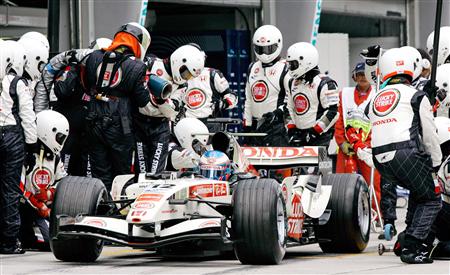
It looks like this season could be interesting. Button has started well this season, although his team has their work cut out, to surpass the engine of Renault. At long last, the team orders have been banned and also the decision to allow tyre changes again, will result in more interesting races.

After qualifying second on the grid on Saturday, Button had harboured hopes that he might make another career breakthrough at the track outside Kuala Lumpur.
In the event he had to settle for another podium to take his points total to 11, equal with Schumacher and seven behind Alonso.
"We want to be winning races and so just being on the podium is disappointing," said Button.
"But I think these two have proved just how quick the
Renault is, especially around this circuit, and that is what we have got to try and achieve and we are just not quick enough at the moment," Button said.
"Joint second or third in the championship is not too bad, but we've got a bit of work to do," he added.